The Global Casino
Book Review

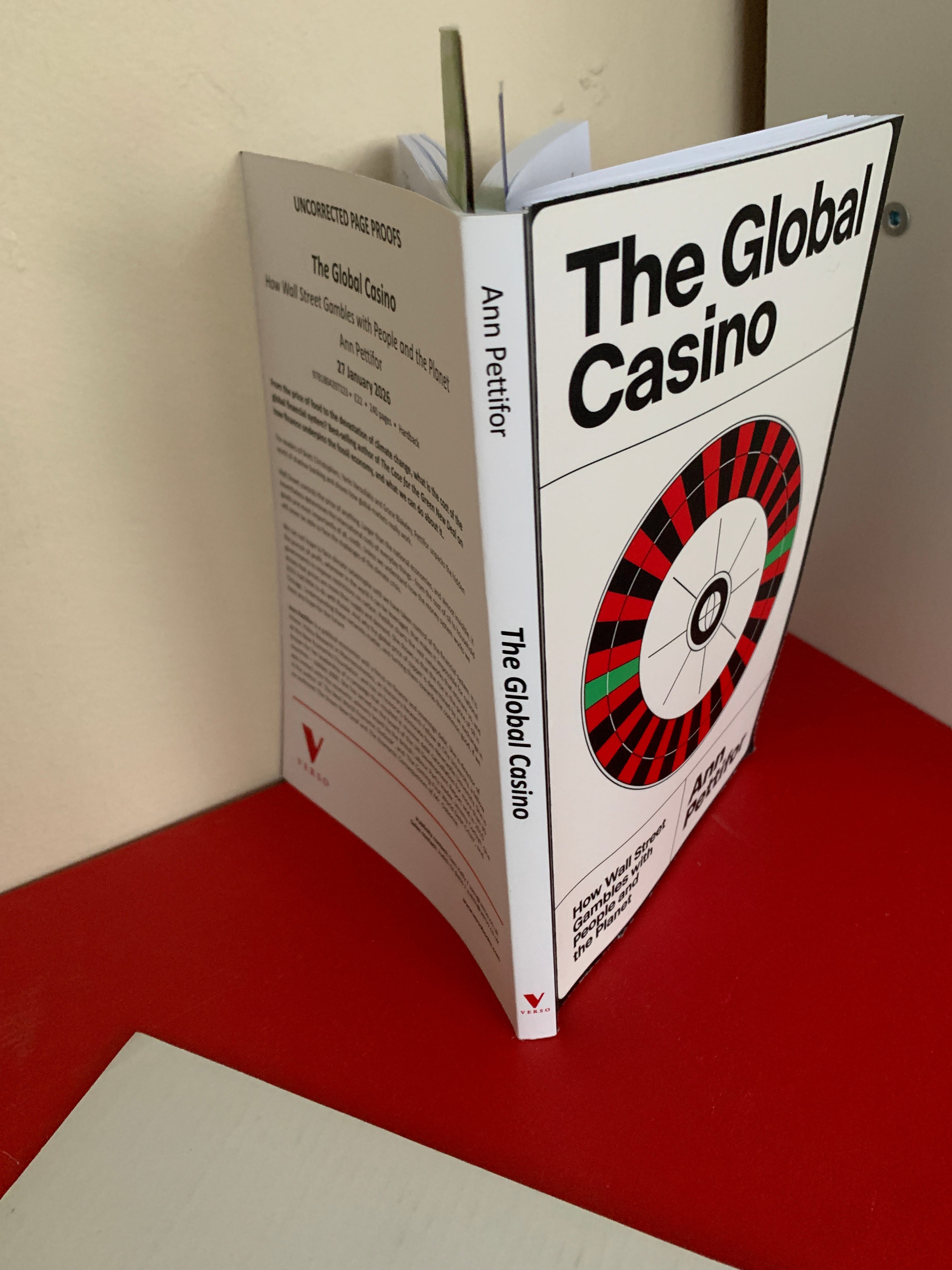
Ann Pettifor: The Global Casino - How Wall Street Gambles with People and the Planet, January 2026, Verso Books, London.
Ann Pettifor’s new book is not a technical treatise in monetary economics. It is an intervention. A moral, institutional, and macroeconomic argument that the global financial order is structurally misaligned with democracy and the biosphere.
Her core thesis is direct:
The global economic system is out of sync with humanity and the planet — and it was designed that way.
This is not rhetoric. It is an institutional claim.
Pettifor frames the modern era around the Nixon Shock.
When President Richard Nixon suspended dollar convertibility into gold, the Bretton Woods architecture collapsed. What followed was not simply floating exchange rates. It was:
• Liberalisation of capital flows
• Deregulation of financial markets
• Weakening of capital controls
• Expansion of offshore finance

Pettifor argues that no coherent alternative design replaced Bretton Woods. Instead, global finance drifted toward what she calls a denationalised, largely unaccountable credit system.
This historical framing is one of the book’s strengths. It reminds readers that monetary systems are political constructions, not natural laws.
One of the book’s most important analytical contributions is conceptual clarity:
“Money is not a commodity.”
“There is not a shortage of money.”
Pettifor insists — correctly in endogenous money terms — that modern money is credit, created by banking systems and underwritten by state authority. It is a social relation based on trust and law.
From this follows a devastating implication:
If money is credit and credit is elastic, then scarcity narratives (“there is no money”) are political choices, not economic inevitabilities. This directly challenges fiscal orthodoxy and supply-side dogma.
Pettifor reverses the usual narrative of ecological crisis. The problem is not excess consumption by households.
It is:
• Chronic demand deficiency
• Export-led overcapacity
• Surplus recycling via finance
• Asset inflation
Her claim that ecological harm stems from overproduction, not overconsumption, is provocative but coherent in a Keynesian framework.
If wages stagnate while productive capacity expands, the system must:
1. Inflate asset prices
2. Expand credit
3. Or seek external demand
This leads to financial fragility and ecological overshoot simultaneously.
A central pillar of the book is the scale and instability of shadow finance.
The shadow banking system — now nearly half of global financial assets — operates outside traditional deposit guarantees and prudential backstops.
It includes:
• Private credit funds
• Money market funds
• Structured finance vehicles
• Repo markets
• BDCs and other non-bank lenders
Shadow banks lack lender-of-last-resort protection yet perform maturity transformation. That makes them structurally vulnerable to runs.
Pettifor describes this as a modern realisation of Hayek’s “denationalised money” — but without stability.
The critique is powerful: deregulated capital flows amplify systemic risk while weakening democratic accountability.
One of the book’s most compelling passages concerns asset scarcity. Capital seeks yield. Yield requires income-generating assets. But such assets are finite:
• Land
• Property
• Infrastructure
• Energy resources
• Even cultural artifacts
When vast pools of mobile capital compete for limited real assets, prices inflate.
This explains:
• Property bubbles
• Commodity super-cycles
• Financialized housing markets
• Resource extraction pressures
The “wall of money” metaphor captures the structural inflationary pressure of financialisation.
Pettifor’s most forceful claim is not economic but political: Unregulated cross-border capital flows weaken democratic sovereignty.
They enable:
Tax avoidance
Capital flight
Political corruption
Regulatory arbitrage
In her telling, financial deregulation erodes trust in institutions — financial, political, and scientific alike.
The system becomes remote, opaque, and unaccountable.
The “Global Casino” metaphor is not hyperbole; it is institutional diagnosis.
Pettifor links the 1971 rupture to contemporary instability — including the recent protectionist turn in the United States.
In her reading, the absence of a rules-based international monetary order produces:
• Persistent imbalances
• Surplus-deficit tensions
• Political backlash
What she calls the “Trump Shock” is therefore not an anomaly but a symptom of systemic disorder.
• Conceptual clarity about money and credit
• Integration of finance, ecology, and democracy
Pettifor demystifies complex systems without oversimplifying them. Yet, there are some challenging questions:
• What concrete institutional design (apart from ICU, International Clearing Union and Keynes’ “bancor” proposal) replaces the current system?
• How feasible are capital controls in a digitized financial architecture?
• Can global coordination be reconstructed in a multipolar world?
• How do emerging markets (EM) fit into her reform proposal?
The book diagnoses brilliantly. Implementation remains politically daunting, but desirable.
The Global Casino is not incremental reformism. It is a call for systemic redesign. It reminds us that:
• Monetary systems are political constructions.
• Credit allocation shapes ecological outcomes.
• Finance without accountability corrodes democracy.
At a moment of geopolitical fragmentation and renewed protectionism, Pettifor’s work is both timely and unsettling. For readers willing to question orthodoxy — especially the myths of “sound finance” and money scarcity — this is essential reading.